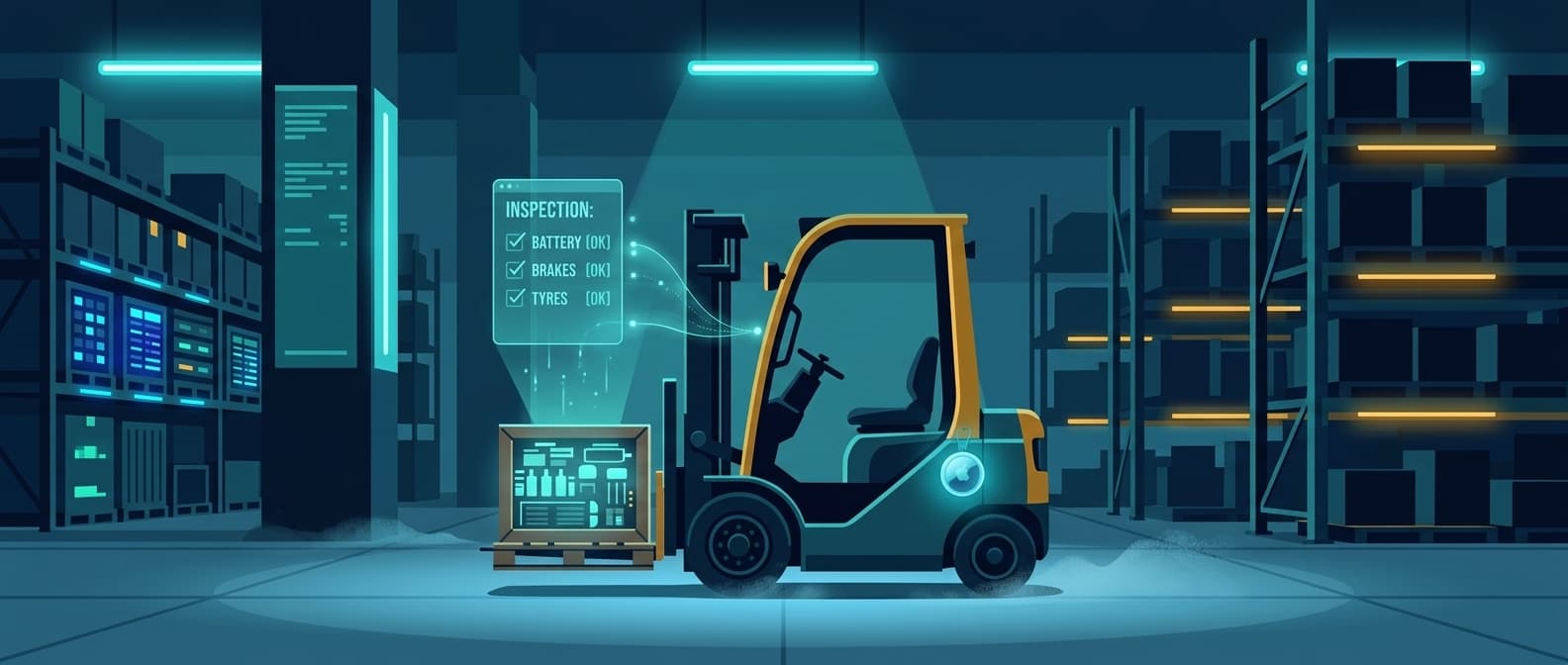
OSHA requires a pre-shift inspection on every forklift, every shift, before anyone drives it. That is 29 CFR 1910.178(q)(7). Not a suggestion. A federal regulation.
85 workers die in forklift accidents every year. Another 34,900 suffer serious injuries. OSHA issues roughly 1,500 forklift-related citations annually, and "powered industrial trucks" consistently lands in the top 10 most-cited standards. The average serious OSHA penalty is $16,131 per violation.
Most of these accidents are preventable. And the single cheapest intervention is the one most warehouses skip: the pre-shift inspection.
Why Paper Checklists Fail
About 70% of warehouses fail to perform pre-shift inspections consistently. The reasons are predictable.
Paper forms get lost. Operators fill them out after the shift (or not at all). Supervisors have no way to verify that an inspection actually happened at the start of the shift versus being backdated at 3pm. When OSHA shows up, the binder of paper forms is either missing, incomplete, or suspiciously uniform.
The bigger problem: paper checklists have no connection to the forklift itself. If a forklift moves from Building A to Building B between shifts, the inspection record stays in Building A. Nobody at Building B knows whether it was inspected.
This is where a forklift inspection app changes the math.
What a Forklift Inspection App Actually Does
A forklift inspection app replaces the paper checklist with a mobile form that:
- Timestamps every inspection with GPS coordinates, so you can prove when and where it happened
- Requires photo evidence for defects, preventing vague write-ups
- Blocks operation until the inspection is complete (when paired with telematics)
- Routes defect reports directly to maintenance, eliminating the "I told someone" excuse
- Generates OSHA-ready reports automatically, no binder organization needed
The inspection takes 3 minutes. That is the same as paper. The difference is accountability.
The Complete OSHA Forklift Inspection Checklist
This is the full pre-shift inspection checklist based on OSHA 29 CFR 1910.178. Use it in your app or print it. Either way, every item needs a pass/fail before the forklift moves.
Visual Inspection (Engine Off)
| Item | What to Check |
|---|---|
| Forks | Cracks, bends, wear on heel, fork lock pins seated |
| Tires | Cuts, gouges, debris embedded, proper inflation (pneumatic) or wear (solid) |
| Mast and chains | Visible damage, chain tension, anchor pin condition |
| Hydraulic system | Hose condition, cylinder leaks, fluid level |
| Overhead guard | Cracks, welds intact, no missing bolts |
| Load backrest | Secure mounting, no bends or cracks |
| Fluid levels | Engine oil, coolant, hydraulic fluid, fuel/charge level |
| Battery (electric) | Connections tight, no corrosion, electrolyte level, case intact |
| Propane tank (LP) | Secure mounting, hose condition, no leaks, tank date current |
| Safety labels | Capacity plate readable, warning labels present |
Operational Inspection (Engine On)
| Item | What to Check |
|---|---|
| Horn | Functional, audible |
| Lights | Headlights, tail lights, warning lights all working |
| Backup alarm | Functional, audible |
| Brakes | Service brake stops forklift, parking brake holds on grade |
| Steering | Smooth operation, no excessive play |
| Mast operation | Lift, lower, tilt forward, tilt back all smooth |
| Side shift | Smooth operation, no sticking (if equipped) |
| Gauges | All readings in normal range |
| Seatbelt | Latches and retracts properly |
| Mirrors | Clean, properly adjusted (if equipped) |
Environmental Check
| Item | What to Check |
|---|---|
| Floor conditions | Oil spills, water, debris in travel paths |
| Clearances | Adequate overhead clearance for mast height |
| Pedestrian areas | Walkways clear, barriers in place |
| Charging area | Ventilation adequate, no ignition sources near batteries |
Any single failed item means the forklift is out of service until repaired. Not "use it carefully." Out of service. OSHA is clear on this.
Top Forklift Inspection Apps Compared
SafetyCulture (iAuditor)
The market leader for inspection checklists across industries. Not forklift-specific, but the template library includes dozens of forklift inspection forms.
- Price: Free for small teams (up to 10 inspections/month), $29/user/month for Premium
- Strengths: Massive template library, offline mode, photo/video capture, analytics dashboard
- Weakness: Generic tool, requires customization for forklift-specific workflows
Whip Around
Built specifically for fleet inspections, including forklifts. Integrates with fleet management systems.
- Price: Starts at $5/asset/month
- Strengths: Purpose-built for vehicle/equipment inspections, defect tracking through resolution, mechanic workflow
- Weakness: Less flexible than SafetyCulture for non-fleet inspections
Fluix
Document management platform with strong inspection capabilities. Popular with enterprises that need inspection data flowing into larger systems.
- Price: Custom pricing, typically $20-30/user/month
- Strengths: PDF form conversion, complex approval workflows, ERP integration
- Weakness: Overkill for small operations, longer setup time
eCompliance (Alcumus)
Safety management platform with forklift inspection modules. Strong in construction and manufacturing.
- Price: Custom pricing based on workforce size
- Strengths: Connects inspections to incident management and training records, regulatory compliance focus
- Weakness: Enterprise-oriented pricing
Free Options
Google Forms and Microsoft Forms work as basic inspection apps. You lose photo requirements, offline mode, and automatic routing, but the price is right for a 3-forklift operation.
The Missing Piece: Knowing Where Your Forklifts Are
Every inspection app has the same blind spot: it assumes you know which forklifts need inspecting on which shift.
In a single-building operation with 5 forklifts, that is a reasonable assumption. In a multi-building campus, a distribution center with 50+ forklifts, or any operation where forklifts move between zones, it breaks down fast.
Common scenarios:
- A forklift gets moved to a different building overnight for a rush job. Morning shift in that building does not know it is there, so it does not get inspected.
- A forklift is pulled off the floor for maintenance but returned to a different zone. The maintenance team marks it as repaired, but the operations team in the new zone never gets the updated inspection status.
- Rental forklifts arrive on site. They are somewhere in the warehouse. Nobody logged where they were staged.
This is where location tracking becomes the foundation for inspection compliance. If you know where every forklift is at the start of every shift, your inspection app can generate the correct checklist for the correct building with the correct forklifts.
How Airpinpoint Closes the Gap
Airpinpoint tracks assets using Apple's Find My network. Attach a Find My-compatible tag to each forklift. The tag broadcasts a Bluetooth signal. Every iPhone, iPad, and Mac in your facility relays that signal to Apple's network. Airpinpoint reads the location and displays your entire forklift fleet on a dashboard.
The practical effect for inspections:
- Shift start: Pull up Airpinpoint and see exactly which forklifts are in each building. Hand the list to your shift supervisor. No guessing.
- Post-maintenance: Confirm the forklift was actually returned to the correct zone after repair before clearing it for operation.
- Rental tracking: See where every rental forklift was staged the moment it arrived.
- Geofence alerts: Get notified when a forklift leaves its assigned zone, which is also when its inspection status needs re-verification.
The tracking does not replace the inspection app. It makes the inspection app accurate. You cannot inspect what you cannot find.
Building a Forklift Inspection Program That Sticks
Technology alone does not solve inspection compliance. Here is the operational framework that makes it sustainable.
1. Make Inspection Part of Key-On
The most reliable trigger for an inspection is the moment an operator turns the key. If your telematics system can lock out the ignition until the app inspection is submitted, do it. If not, make inspection completion a condition of clocking in for the shift. The closer the inspection is to the start of operation, the more likely it happens.
2. Keep It Under 3 Minutes
If your checklist takes 10 minutes, operators will skip it or rush through it. The OSHA-required items can be checked in under 3 minutes by a trained operator. Do not add nice-to-have items that inflate the time. Save those for weekly or monthly detailed inspections.
3. Act on Defect Reports Within 4 Hours
Nothing kills inspection compliance faster than operators reporting defects that nobody fixes. If an operator flags a hydraulic leak on Monday and the same forklift is still leaking on Thursday, they stop reporting. A 4-hour response time for critical defects (brakes, steering, hydraulics) and 24 hours for non-critical items (scratched paint, dim lights) keeps operators engaged.
4. Review Completion Rates Weekly
Your inspection app generates completion data. Use it. If Building C consistently has 60% completion rates while Buildings A and B are at 95%, the problem is not the app. It is the Building C supervisor. Address it before OSHA does.
5. Connect Location Data to Inspection Data
This is the step most operations miss. When you know a forklift moved from Zone 1 to Zone 3 at 2am (via Airpinpoint), and the Zone 3 morning shift inspection log shows no record of that forklift, you have found your compliance gap before OSHA does.
OSHA Penalties You're Avoiding
Forklift violations fall under multiple OSHA standards. The fines add up:
| Violation Type | Penalty Range |
|---|---|
| Serious (per instance) | Up to $16,131 |
| Willful or repeated | Up to $161,323 |
| Failure to abate | Up to $16,131/day |
A single OSHA inspection that finds 10 forklifts without inspection records is 10 separate violations. At $16,131 each, that is $161,310 for something a 3-minute inspection would have prevented.
Repeat violations within 5 years escalate to the willful category. One warehouse chain was fined $470,000 for repeated forklift safety violations across three facilities.
The 3-Minute Investment
A forklift inspection takes 3 minutes. For a 50-forklift, 2-shift operation, that is 300 minutes per day, or about 5 labor hours. At $25/hour, the daily cost is $125.
A single OSHA serious violation costs $16,131. A single forklift fatality costs an average of $1.4 million in direct costs, plus immeasurable damage to your workforce and reputation.
The ROI calculation is not close.
Pick an inspection app. Attach a tracking tag to every forklift. Run the checklist every shift. Three minutes. That is the entire program.
Apple stops at 32 AirTags per account
Airpinpoint tracks unlimited tags in one dashboard, with location updates about every 5 minutes, geofence alerts, and a REST API, from $11.99 per tag per month.
Free to start. Works with the AirTags you already own. 6,700+ tags under management.
