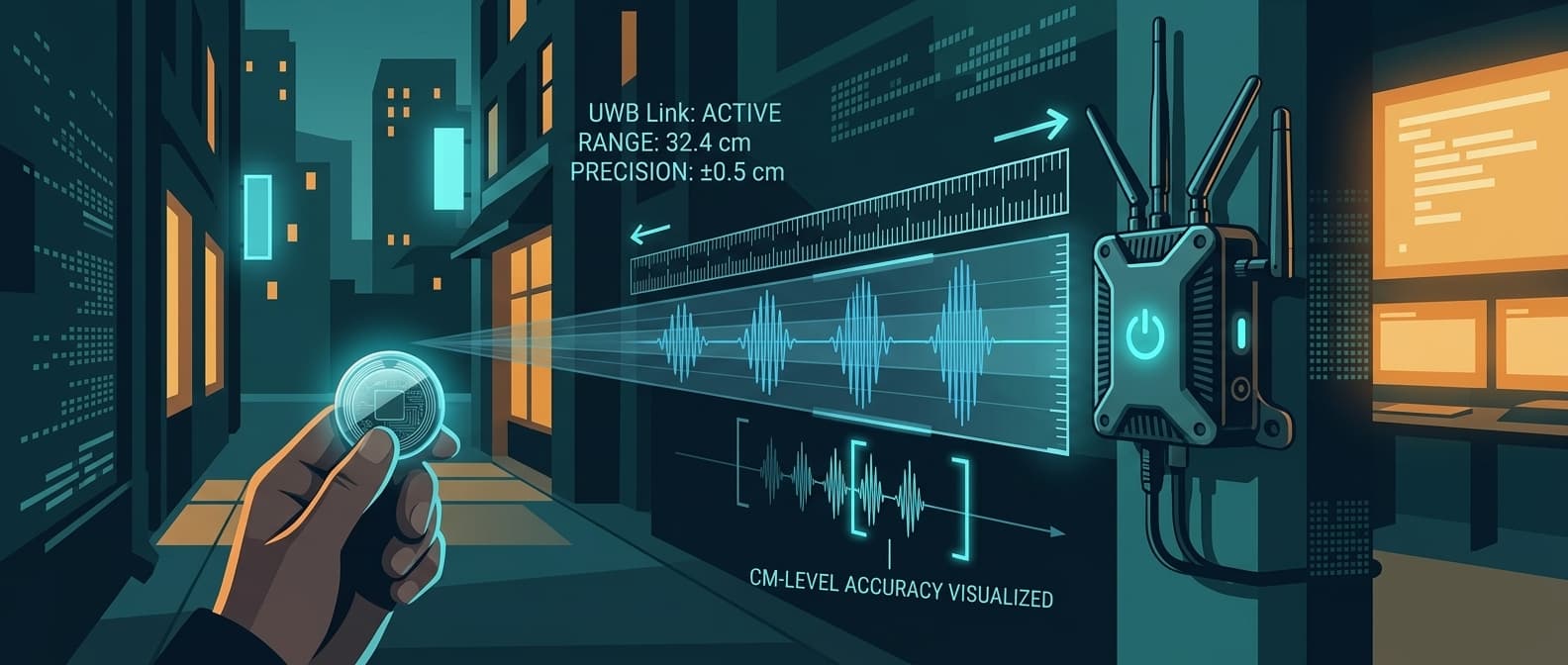
UWB Asset Tracking: Centimeter Accuracy Without the $100K Infrastructure
UWB tracks to 10-centimeter accuracy. Dedicated UWB infrastructure costs $100,000+. Apple put a UWB chip in a $29 AirTag.
That contradiction is worth understanding. UWB (Ultra-Wideband) is the most precise radio positioning technology available today. For decades, it required custom hardware installations that only automakers and aerospace companies could justify. Now it's in consumer trackers.
How UWB Works
UWB measures distance using time-of-flight. A device sends a radio pulse. The receiver measures how long that pulse took to arrive. Since radio waves travel at the speed of light (roughly 1 foot per nanosecond), the time measurement translates directly to distance.
What makes UWB different from WiFi or Bluetooth ranging: the pulses are extremely short. About 2 nanoseconds, per the IEEE 802.15.4z standard. Short pulses spread across a wide frequency band (500 MHz+), which gives UWB two advantages that matter for tracking.
Multipath resistance. In a warehouse full of metal shelving, radio signals bounce everywhere. Longer signals (like WiFi) can't distinguish the direct path from the reflections. UWB's 2ns pulses are short enough to separate the direct signal from echoes, maintaining accuracy where other technologies fail.
Centimeter precision. BLE positioning works by measuring signal strength (RSSI), which degrades unpredictably with distance, walls, and interference. UWB measures time, which is a physical constant. The result: 10-30cm accuracy in line-of-sight, compared to 3-5 meters for BLE RSSI.
The UWB Accuracy Spectrum
Not all UWB deployments achieve the same accuracy. The numbers depend on environment and infrastructure density.
| Condition | Typical Accuracy | Notes |
|---|---|---|
| Line-of-sight, calibrated | 5-10 cm | Lab conditions, multiple anchors |
| Open industrial floor | 10-30 cm | Standard RTLS deployment |
| Through drywall/wood | 30-50 cm | Signal attenuation, still usable |
| Through metal/concrete | 0.5-2 m | Significant degradation |
| Non-line-of-sight (NLOS) | < 20 cm avg error | IEEE 802.15.4z improvement over prior standards |
For comparison: GPS is 3-5 meters outdoors and useless indoors. WiFi fingerprinting is 3-8 meters. BLE RSSI is 3-5 meters. BLE 5.1 with Angle-of-Arrival reaches 0.5-1 meter. UWB is the only sub-meter technology that works without fixed infrastructure density requirements.
The UWB Chip Landscape
Three companies dominate UWB silicon. Each serves different markets.
Qorvo DW3000 family. The workhorse of dedicated RTLS systems. Supports IEEE 802.15.4z on Channel 5 (6.5 GHz) and Channel 9 (8 GHz). Delivers 10cm ranging accuracy and 5-degree angular measurement. Data rates up to 6.8 Mbps. Optimized for battery-powered tags. Used in Pozyx, Sewio, and most industrial tracking platforms. Interoperable with Apple U1 and U2.
NXP Trimension SR150/SR040. Targets access control and secure ranging. Includes dual-RX for 3D Angle-of-Arrival. FiRa MAC compatible. Priced around $3.96 per chip at 1,000 units. Samsung's Galaxy SmartTag2+ uses NXP's SR200 solution.
Apple U2. Apple's in-house UWB chip, found in iPhone 15+, Apple Watch Series 9+, and AirTag 2. Not sold separately. Integrated with the Find My network. The U2 extends Precision Finding range from 15 meters (U1) to approximately 60 meters.
What Dedicated UWB RTLS Costs
A dedicated UWB real-time location system requires three things: anchors mounted on walls/ceilings, tags on every asset, and software to process the data.
Anchor costs. $50-200 per unit. You need one anchor per 400-900 square feet for full coverage. A 50,000 sq ft warehouse needs 55-125 anchors. That's $2,750-$25,000 in anchors alone.
Tag costs. $100-300 per asset for industrial-grade UWB tags with battery life measured in months, not years.
Infrastructure. Every anchor needs power and ethernet. Running cable to 100+ ceiling-mounted devices in an existing building adds $10,000-50,000+ in installation labor and materials.
Software licensing. Platforms like Sewio, Pozyx, and Zebra charge annual licensing fees. Expect $10,000-50,000/year depending on the number of tracked assets and features.
Total cost for a single facility: $50,000-200,000+ for a medium warehouse. Roughly $1-2 per square foot when you factor in everything.
| Cost Component | Range | Notes |
|---|---|---|
| UWB anchors (100 units) | $5,000-$20,000 | Ceiling/wall mounted |
| UWB tags (500 assets) | $50,000-$150,000 | Industrial grade, replaceable battery |
| Cabling & installation | $10,000-$50,000 | Ethernet + power to each anchor |
| Software license (annual) | $10,000-$50,000 | Per-asset or per-facility pricing |
| Year 1 total | $75,000-$270,000 | Single facility |
This is why UWB has historically been limited to automotive manufacturing, aerospace, and healthcare. The ROI calculation only works when asset values are high and position accuracy is mission-critical.
How AirTag 2 Changes the Math
AirTag 2 ships with Apple's U2 Ultra-Wideband chip. Same core technology. Different delivery model.
$29 per tag. No per-asset software licensing. No annual fees for UWB functionality.
Zero infrastructure. No anchors to mount. No ethernet to run. The "infrastructure" is the 2 billion+ Apple devices in the Find My network, which already exist in your employees' pockets.
60-meter Precision Finding. When an iPhone 15+ or Apple Watch Series 9+ is within 60 meters of an AirTag 2, you get directional arrows and distance readout. This is real UWB ranging, not BLE approximation.
Dual-mode tracking. Beyond UWB range, AirTags fall back to BLE. Any Apple device that passes within Bluetooth range (~30 feet) reports the tag's encrypted location to the Find My network. You lose centimeter precision but keep approximate location worldwide.
| Dedicated UWB RTLS | AirTag 2 + Airpinpoint | |
|---|---|---|
| Accuracy (close range) | 10-30 cm | Directional + distance via UWB |
| Accuracy (facility-wide) | 10-30 cm everywhere | BLE zone-level (~10m) |
| Range | Facility coverage area | 60m UWB, worldwide BLE |
| Cost per tag | $100-300 | $29 |
| Infrastructure | $50K-200K per facility | $0 (uses Find My network) |
| Battery life | 3-12 months | 12+ months (CR2032) |
| Setup time | Weeks to months | Minutes |
| Best for | Sub-meter tracking everywhere | Locate, find, and manage assets |
Where Each Approach Wins
Dedicated UWB RTLS wins when you need continuous sub-meter positioning across an entire facility. Automotive assembly lines where a robot needs to know a part's position within 10cm. Hospital operating rooms tracking surgical instruments in real time. Sports arenas tracking player movement for analytics.
AirTag UWB wins when you need to find and manage assets across locations without dedicated infrastructure. Construction equipment across job sites. IT assets across office floors. Rental inventory that moves between facilities. Fleet vehicles and trailers. Any situation where "which site is it at, and can I walk to it?" matters more than "what are its exact XYZ coordinates at all times?"
Most businesses fall into the second category. The question isn't "where exactly is this asset right now, within 10cm?" It's "where did we leave that generator?" or "is that trailer still at the Dallas site?"
The Technology Standards Behind UWB
UWB isn't proprietary. It's built on open standards that ensure interoperability.
IEEE 802.15.4z (2020). The foundational standard for enhanced UWB physical layers and ranging. Defines the pulse structure, channel assignments, and security mechanisms. The "z" amendment specifically improved ranging integrity, accuracy, and resistance to distance manipulation attacks.
FiRa Consortium. Industry group (Apple, Google, Samsung, NXP, Qorvo, and 100+ members) that defines UWB interoperability profiles on top of IEEE 802.15.4z. FiRa ensures that a Qorvo-based tag can range with an Apple U2 chip.
CCC (Car Connectivity Consortium). Defines UWB for automotive digital keys. Your iPhone can unlock your car because both use UWB ranging per CCC specifications.
UWB vs Everything Else
| Technology | Accuracy | Range | Power | Infrastructure | Cost/Tag |
|---|---|---|---|---|---|
| UWB (dedicated) | 10-30 cm | 50-100 m | Medium | High ($50K+) | $100-300 |
| UWB (AirTag 2) | Directional | 60 m UWB | Low | None | $29 |
| BLE RSSI | 3-5 m | 30-100 m | Very low | Low-Medium | $5-30 |
| BLE 5.1 AoA | 0.5-1 m | 30-100 m | Low | Medium | $10-50 |
| WiFi RTT | 1-3 m | 50-100 m | High | Existing WiFi | N/A |
| Passive RFID | 1-2 m | < 10 m | None (passive) | High | $0.10-5 |
| GPS | 3-5 m | Outdoor only | High | None | $20-200 |
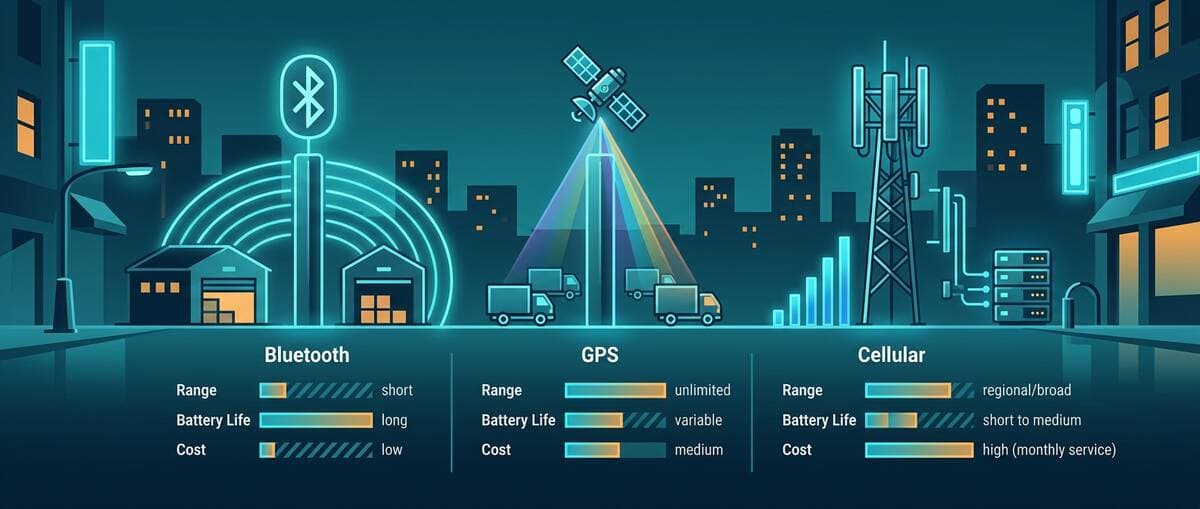
The gap in the market is clear. Dedicated UWB gives you the best accuracy but costs a fortune. GPS works outdoors but not in. BLE is cheap but imprecise. AirTag 2 sits in a unique position: real UWB hardware at consumer pricing, backed by the largest device network on earth.
Getting Started with UWB Asset Tracking
If you need centimeter-level continuous positioning in a single controlled facility, evaluate dedicated UWB from Pozyx, Sewio, or Zebra. Budget $100K+ and 3-6 months for deployment.
If you need to track assets across multiple sites, find misplaced equipment quickly, manage inventory locations, and get geofence alerts, Airpinpoint with AirTag 2 gives you UWB precision finding plus network-wide BLE tracking. No infrastructure. No installation. Deploy in an afternoon.
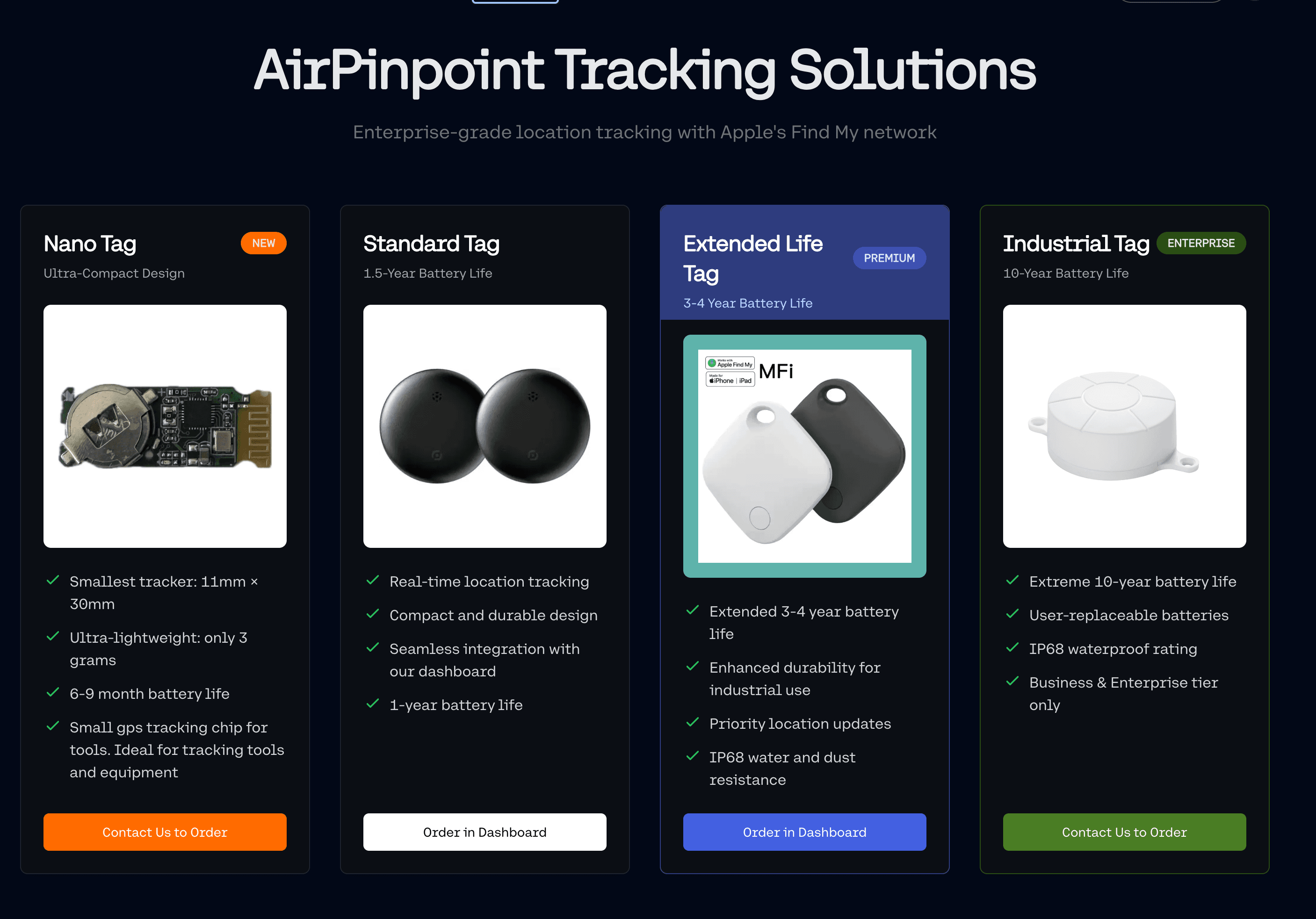
Airpinpoint provides the business layer that AirTag lacks: multi-user dashboards, location history, geofence alerts, inventory management, API webhooks, and fleet-wide visibility. The UWB chip in every AirTag 2 handles the precision. Airpinpoint handles the operations.
 Our Solution